
Identifying with Humans
Self Identification
The same person could identify himself as father, as friend, as musician, co-worker, european, or even as human. Each identificational frame comes with very well researched and predictable attitudes, thoughts and behaviors. In a given context the person would identify with one of all possibilities, and could switch anytime, for example when a new cue appears. Research in the realm of self categorization theory can even predict under which circumstances this switching in identification occurs. One experiment for example showed, that female sport teachers rated possible injuries differently, when either their identification with women or as athletes was emphasized. A scar on the face for example was rated more negative by the group that had to identify as women, than in the one, that had to identify as athletes. To be clear: although the female sport teachers were assigned randomly to these identification groups, the researchers were able to trigger specific identifications (e.g. just by asking to tell their gender), and by this different attitude outcomes.
When only ingroup members (people who are very similar to the person) are present, people tend to identify more individualistically. On the other hand, when people are present who differ from the person, this person tends to identify as a member of the other group. An example makes this clearer: if the female sports teacher from above is surrounded by female sport teachers, she will likely ‚be herself‘, see herfself as an individual. If she would be surrounded by male sport teachers, she will likely stronger identify as a female athelete. Experiments show, that this is the case.

The self-identification as a member of a certain group furthermore leads to a more competitve view of the other group. The female athlete in our example would therefore tend to have a stronger bias against male sport teachers, as well as more negative feelings. The theory of self-identification thus is a valueable model in explaining stereotypes and racism (but also sexism, ageism, ableism, etc.). It is also fundamental to design preventions and interventions for these misanthropic attitudes.
While the negative outcomes against other groups could lead one to think, that self-identification as a group member is something we have to overcome, there is more to the picture. First of all, this form of self-identification seems to be rather general – human beings just tend to do that – and an intervention or prevention of this kind of thinking therefore doesn’t look to be promising. Furthermore it is extremly dependent on the context. The female sports teacher for exmple could go home and start to identify as ‚mother‘ while being with her child. This strong context dependency would also oppose the strategy of reducing self-identification, because there is no real anchor to grip. Would we be able to stop one form of identification (e.g. nationalism), another would simply emerge.
But there is another option we have, that still enables people to identify as a group, while even reducing bias and stereotypes against other human groups – identification with a superordinate category.
Superordinate Categories

We’ve established that identifying as a group member leads attitudes towards the ingroup to get more positive, while attitudes towards outgroups get more negative. To overcome this negative feelings towards the outgroup, we need superordinate categories. These are groups in which the former ingroup, as well as outgroup can both be integrated. The male and female sports teachers may in one situation have a hostile attitude towards one another, but if they had a competition against another school, they would tend to simply identify as athletes from school A. In this case, the athletes from school B would be seen more negative, but at least we brought two groups together, that in the situation before were hostile to one another.
If we think this further we could imagine situations in which the schools A and B can be integrated. In a world cup for example, all of the athletes could identify with their nation and thus suddenly come along with each other – other nations on the other hand will be seen less positive. The final option for these superordinate categories that psychologists were concerned with for many years, is the self-identification with all of humanity. In this special case of identification, all human beings are integrated in our cognitive ‚group‘, with one important difference to the options before: there is no group left, that can be the aim of hostile feelings and attitudes. Many researchers argue and also show, that this kind of self-identification has very positive outcomes on many altruistic outcomes, like helping behavior or the willingness to donate to human rights NGOs.

As we are interested in ways to strengthen positive and reduce negative attitudes towards animals, we have to take the next logical step. Imaginge the red circle symbolizes the self-identification with all of humanity. It becomes clear, that it a) has negitive outcomes for the green circle, and b) there still is a group that experiences these outcomes (green circle), and c) there is a possibility to integrate red and green into a superordinate category (blue). If we, for example, identify as humans, we might have positive attitudes towards other humans, but not for cows, and thus still justify animal agriculture. If we cognitively see both species as parts of the animal kingdom (superordinate category, blue circle), it is likely that these justifications for animal use would be reduced, and as a result less animal ‚products‘ would be used. Just to be clear: it does not mean, that the person somehow identifies as ‚cow‘ or anything like this, but only that both groups (humans and e.g. cows) are subsumed under a higher category (animal kingdom).
While the positive effects on attitudes and intentions of identifying with all humans and even identifying with nature (as the highest superordinate category) have been researched very well, the research on self-identification as a part of the animal is a rather new idea. Although this subject was rather in the periphery of psychological research, the authors Amiot and Bastian (2020) managed to get their seven-study-paper published in one of the most renowned journals on social psychology, and therefore in the center of psychological research and discourse. In the next section we will focus on the results of this paper, and its implications for the identifiation with animals.
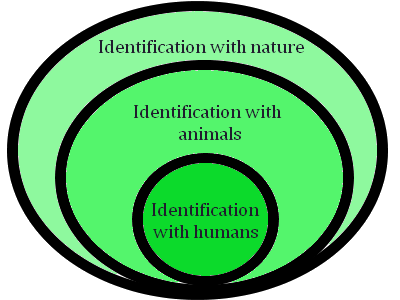
Identifying with animals
In their paper, Amiot and Bastian were able to show that there are three distinct ways in which people can identify with animals – each with very different outcomes. These three factors were found via exploratory and confirmatory factor analysis (EFA & CFA) – statistical methods with which response clusters can be found. The authors were able to reduce their questionnaire to 15 questions, which represent the three factors.

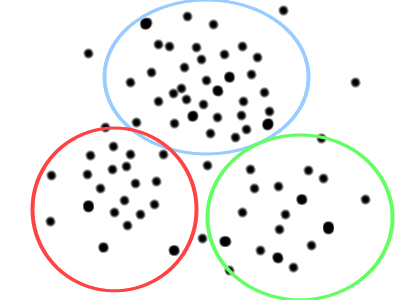
The three possibilities (or ‚dimensions‘) of identifying with animals which were found, were called: human-animal-similarity, animal pride, and solidarity with animals. Each of them and their impact on peoples attitudes, intentions and tendencies are summarized below.
Human-Animal-Similarity
People whose responses reflect this dimension, tend to be aware of the biological similarities between humans and other animals. They therefore more likely think that animals are similar to humans, are able to experience complex emotions (e.g. love, pride, worry, …), and have a high mental capacity as well as moral worth. High human-animal-similarity is also related to meat avoidance for moral and ecological reasons.
Animal Pride
While human-animal-similarity-people tend to attribute human characteristics to animals (e.g. complex emotions), people with high animal pride scores tend to do the opposite. They emphasize the ‚animalistic‘ characteristics of humans, and therefore bring ‚humans‘ closer to ‚animals‘. Although they also perceive humans as a part of the animal kingdom, they have kind of a social darwinstic view: ‚humans are animals, but we are superior and thus can exploit other species‘. So in this case, identifying with the superordinate category (animal kingdom) has – for the first time – a negative effect for the outgroup (non-human animals). Animal pride thus endorses a competitive and hierarchical orientation – and not just regarding animals. People with high animal pride scores also tend to endorse nationalism and social dominance orientation (a form of orientation that is closely linked to racism, sexism, etc.). Regarding animals, these people show higher speciesism, show no ambivalence toward meat-eating and would rather donate money to human than to animal welfare purposes. Negative attitudes towards animals, because of bringing ‚humans‘ cognitively closer to ‚animals‘, is closely related to the phenomenon of terror management theory.
Solidarity with Animals
In 2017 the authors already investigated a form of identification, which was found in this study as well: solidarity with animals. It represents a psychological bond and commitement to animals. While animal pride is a rather hierarchical orientation, solidarity is an egalitarian orientation. It is related to lower speciesism, very high meat avoidance for moral reasons. Furthermore people who tend to identify solidaric also tend to donate money more likely to an animal welfare/liberation NGO, than to a human welfare NGO. They also are the ones with the highest desire to help animals and the ones that have the highest intentions to engage in collective action. Although human-animal-similarity shows many positive outcomes, the best outcomes for the animal liberation movement are found in people who identify solidaric with animals.
Research on identification with animals is a very new and promising perspective in the psychological literature. The three dimensions mentioned above can be very helpful especially for animal liberation NGOs, which can tailor their campaigns and other forms of collective action to their targets, and by that reducing costs massively. Targeting people high in solidarity would likely mean to find the people who are most commited to animal liberation goals, and who are willing to donate and engage in collective action.
 studies in green.